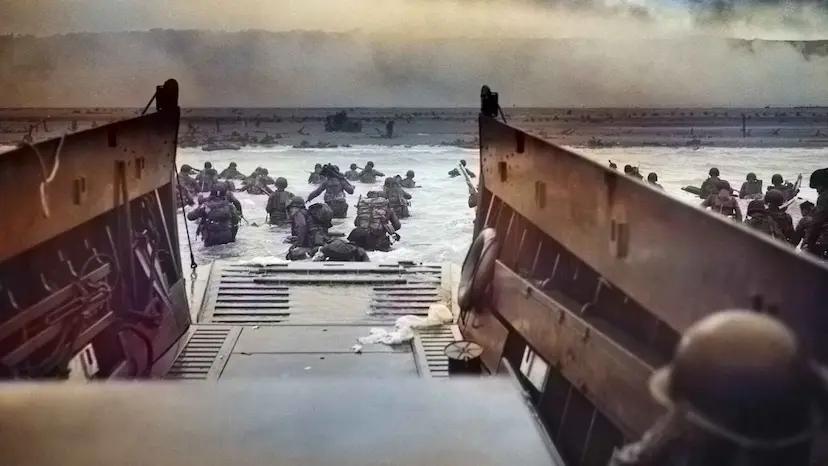
More About D-Day: Allies storm Normandy's coast
On June 6, 1944, Supreme Allied Commander General Dwight D. Eisenhower gives the go-ahead for the largest amphibious military operation in history: Operation Overlord, the Allied invasion of northern France, commonly known as D-Day.
By daybreak, 18,000 British and American parachutists were already on the ground. An additional 13,000 aircraft were mobilized to provide air cover and support for the invasion. At 6:30 a.m., American troops came ashore at Utah and Omaha beaches.
The British and Canadians overcame light opposition to capture Gold, Juno and Sword beaches; so did the Americans at Utah. The task was much tougher at Omaha beach, however, where the U.S. First Division battled high seas, mist, mines, burning vehicles—and German coastal batteries, including an elite infantry division, which spewed heavy fire. Many wounded Americans ultimately drowned in the high tide. British divisions, which landed at Gold, Juno, and Sword beaches, and Canadian troops also met with heavy German fire.
History Shorts: The Night Before D-Day
But by day’s end, 155,000 Allied troops–Americans, British and Canadians–had successfully stormed Normandy’s beaches and were then able to push inland. Within three months, the northern part of France would be freed and the invasion force would be preparing to enter Germany, where they would meet up with Soviet forces moving in from the east.
Before the Allied assault, Hitler’s armies had been in control of most of mainland Europe and the Allies knew that a successful invasion of the continent was central to winning the war. Hitler knew this too, and was expecting an assault on northwestern Europe in the spring of 1944. He hoped to repel the Allies from the coast with a strong counterattack that would delay future invasion attempts, giving him time to throw the majority of his forces into defeating the Soviet Union in the east. Once that was accomplished, he believed an all-out victory would soon be his.
For their part, the Germans suffered from confusion in the ranks and the absence of celebrated commander Field Marshal Erwin Rommel, who was away on leave. At first, Hitler, believing that the invasion was a feint designed to distract the Germans from a coming attack north of the Seine River, refused to release nearby divisions to join the counterattack and reinforcements had to be called from further afield, causing delays.
By daybreak, 18,000 British and American parachutists were already on the ground. An additional 13,000 aircraft were mobilized to provide air cover and support for the invasion. At 6:30 a.m., American troops came ashore at Utah and Omaha beaches.
The British and Canadians overcame light opposition to capture Gold, Juno and Sword beaches; so did the Americans at Utah. The task was much tougher at Omaha beach, however, where the U.S. First Division battled high seas, mist, mines, burning vehicles—and German coastal batteries, including an elite infantry division, which spewed heavy fire. Many wounded Americans ultimately drowned in the high tide. British divisions, which landed at Gold, Juno, and Sword beaches, and Canadian troops also met with heavy German fire.
History Shorts: The Night Before D-Day
But by day’s end, 155,000 Allied troops–Americans, British and Canadians–had successfully stormed Normandy’s beaches and were then able to push inland. Within three months, the northern part of France would be freed and the invasion force would be preparing to enter Germany, where they would meet up with Soviet forces moving in from the east.
Before the Allied assault, Hitler’s armies had been in control of most of mainland Europe and the Allies knew that a successful invasion of the continent was central to winning the war. Hitler knew this too, and was expecting an assault on northwestern Europe in the spring of 1944. He hoped to repel the Allies from the coast with a strong counterattack that would delay future invasion attempts, giving him time to throw the majority of his forces into defeating the Soviet Union in the east. Once that was accomplished, he believed an all-out victory would soon be his.
For their part, the Germans suffered from confusion in the ranks and the absence of celebrated commander Field Marshal Erwin Rommel, who was away on leave. At first, Hitler, believing that the invasion was a feint designed to distract the Germans from a coming attack north of the Seine River, refused to release nearby divisions to join the counterattack and reinforcements had to be called from further afield, causing delays.
Did you know you can follow any of our 175 Special Interest calendars and stay informed better than ever before? See them here. You can also create your own public or private calendar here. Post events to your calendar and ours at the same time! Terms and conditions may vary based on the policies of your local Town Planner publisher.
To learn more, watch our intro video!